Tuesday, February 28, 2012

HISTORICAL FICTION

 “All life demands struggle. Those who have everything given to them become lazy, selfish, and insensitive to the real values of life. The very striving and hard work that we so constantly try to avoid is the major building block in the person we are today.”
– Ralph Ransom


Where the Red Fern Grows is a great middle-school level book for dealing with the idea of perseverance in the face of adversity.  The main character, Billy, wants to buy some hunting dogs.  However he’s poor, so the only way to get the dogs is to earn money and save up for them.  He spends 2 years saving and working toward this goal by picking blackberries and trapping and selling animal furs, which he would not otherwise have had to do.  That is an incredible demonstration of perseverance and I would like to ask students of his same age what they are willing to work toward and sacrifice for over a 2 year period!  When Billy finally does get his dogs he has to take them through extensive training.  This is time-consuming and it’s work.  On his very first hunt he makes a promise to his dogs that if they tree a raccoon he will chop down that tree.  This happens on his first hunt, but the tree is enormous and will take days to cut down.  Rather than abandon the undertaking (who would know of his promise?), he works for almost 3 days to complete the task.   The story ends with Billy tragically losing both dogs.  The way he faces this loss and moves on again offers an example of how to deal with adversity head on and press forward.

Though the setting and characters do not offer what would today be considered "diversity," it does offer an interesting diversity of a kind.  Set in the Ozark Mountains just before the Great Depression, it’s a historical fiction that gives a glimpse into the very simple, “bare essentials” way of life that belonged to the mountain people of that era.  

Monday, February 20, 2012

PERSEVERANCE IN THE FACE OF ADVERSITY

“A pessimist sees the difficulty in every opportunity; an optimist sees the opportunity in every difficulty.” -Winston Churchill
I chose the above theme because I wanted to speak to the lack of endurance I see in many of my students. The many difficulties of their lives make them feel unable to pursue anything, and if they do attempt something they often easily give up. I want to offer them encouraging examples and lessons from others who've faced great difficulties but didn't let their problems stop them from fighting to acheiving their goals, win or lose. They persevered in the face of adversity!

AUTOBIOGRAPHY


“A good story should alter you in some way; it should change your thinking, your feeling, your psyche, or the way you look at things. A story is an abstract experience; it's rather like venturing through a maze. When you come out of it, you should feel slightly changed. “ – Allen Say (from an interview with Stephanie Loer).


Drawing From Memory is a graphic/illustrated autobiography by writer/artist Allen Say.  It documents the tenacity and perseverance he had to exert as a boy to become the apprentice of one of Japan’s leading cartoonists.  His fascinating story models the value of discipline and hard work in order to pursue a goal.  The book will be especially compelling to middle school boys.  Lexiled at 560, the graphic character of the book makes it more accessible for readers in the consolidation phase.  However, the book is so well written that more advanced readers will find it equally enjoyable.


Wednesday, February 15, 2012

THEME JUSTIFICATION

“Great works are performed not by strength, but by perseverance.” – Samuel Johnson, English poet, 1709-1784


UNIT THEME

My children’s literature theme is Perseverance in the Face of Adversity.  My goal is to empower students with literature that points to positive models of people who have faced difficult tasks, hardship or danger and have chosen to persevere rather than give up.

SOCIAL IMPLICATIONS OF THIS THEME

Some have described the current generation as being in a kind of freefall.  “There is a sense of drift, in which people yield to a meaningless determinism, as if their efforts do not matter and as if they have no control over their lives.”  This description of a civilization in disintegration was offered by renowned historian Sir Arnold Toynbee in the 1940s.  One evidence of such collapse, he claimed, would be escapism.(1)

The Keiser Family Foundation reports that our youth spend more than 53 hours a week on average using entertainment media.(2) But life has a purpose beyond entertaining ourselves.  It is hard to imagine any heroic figure who has accomplished anything of lasting value devoting that much time to diversionary activity.  It’s hard to imagine a nation of people who could accomplish much if this were their norm – and it could become our norm.  Historically people have understood that they must undertake long-term learning tasks, such as musical study or apprenticeships, in which effort will be sustained and gratification delayed.  However, today’s youth are unaware that entertainment media is systematically training them toward a short focus span that precludes long-term goals beyond its use. 

HOW THIS THEME ADDRESSES SOCIAL CONSEQUENCES

A common theme in current entertainment media is the idea that avoiding effort and responsibility is a reasonable objective.  I wish to counter with the following messages:

·         Positive character traits result from persevering, regardless of the outcome.
·         In order to grow, people must attempt difficult tasks and persevere to complete them.
·         Hard work and discipline are elements of persevering.
·         Perseverance will at times require self-denial.

GRADE LEVELS THIS THEME WILL ADDRESS

My theme will be developed for 6-8 grade students.  My purpose for choosing this age is that in classical education it is recognized that children in this stage are learning to reason and argue – in other words, they have a “cause!”  Thus, this stage suits well for grappling with a concept that challenges their preference.  While this is the focus age, texts will be chosen that span the stages of reading fluency in order to reach readers who for varying reasons may still be at an early reading stage, as well as more mature readers.

__________________________________________________________________________________
1 Veith, G.D. (1995).  Postmodern Times, a Christian Guide to Contemporary Thought and Culture.  (pp. 44-45).  Crossway Books.
2 Kaiser, F. (2010, January 20).  The Kaiser Family Foundation.  Retrieved from http://www.kff.org/entmedia/entmedia012010nr.cfm.

Monday, February 13, 2012

FAVORITE FOLKTALES

There are many wonderful folktales that come from India.  One Grain of Rice is a story of how a peasant girl outwits the mighty Raja.  I love the beautiful illustrations and this tale teaches a useful content concept – exponential growth – as well as offering a great example of how humility mixed with wisdom can get you far.


 There are lots of American Indian stories about Coyote and his role in what exists and why.  Coyote Places the Stars is a wonderful way to introduce kids to the idea of constellations.  I have read this with kids and then had them create their own constellation and its story.

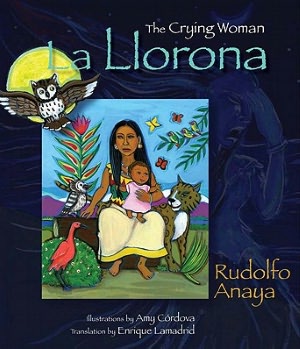
Ask any Mexican kid about La Llorona and their eyes will get really big!  They all know at least one of its numerous versions.  Only recently was it made very gruesome in a movie version.  Before that it was not told as something gruesome, but just a scary ghost story – with a warning that infidelity might be very costly!  This version is good because it is written by native Spanish speakers and has a very authentic Mexican flavor.


I’ve actually never read The Mud Pony in English, but I like the Spanish version (El Poni De Barro).  It captures the closeness to the earth that Native Americans have had in way that is accessible to kids – through the horse. 

Sunday, February 12, 2012

TRADITIONAL LITERATURE


As an introduction to this unit, I chose Julius Lester's beautifully written and illustrated tale of John Henry.  Here is the legend of the man who challenged the new steamdrill.  The stakes were high:  if the power of John Henry's own hand could not outdo the steam drill, he and countless other workers would become obsolete.  My question to students would be, what is the "steam drill" in your life that threatens to overtake you?  Will you fight it or give up?  How do you want to be remembered?