Saturday, April 28, 2012

SCIENCE FICTION


“Those who don’t build must burn.  It’s as old as history and juvenile delinquents.” – Faber, Fahrenheit 451.

Fahreinheit 451 by Ray Bradbury.  I struggle with the title I’ve given this theme.  Maybe I should have called it “Purpose” in the face of adversity.  There is a kind of adversity called “inertia” that needs to be addressed.  If I’m a middle school kid, they send me to school every day and, oddly enough, the teachers expect me to exercise self-discipline and, well…work!  I ignore this and play instead, but they have the audacity to send things home to do as well!  Again, I ignore this, go home and play, drop down at about 10:00 or 11:00 and start the whole thing over again the next day.  I think my purpose has been pretty well defined.
If we’re going to teach kids the value of persevering, maybe we should also help them become aware of the need to break through their own matrix of reality.  This is what happens to Montag, the protagonist of Fahrenheit 451.  “It was a pleasure to burn,” and life is pleasant in his world of burning books and seeking entertainment.  Then one day he meets Clarrise, who causes him to contemplate things he has never before considered and asks him the haunting question, “Are you happy?” 

At its most basic level Fahrenheit 451 is about censoring books, but it also addresses another kind of censorship – the censorship of human purpose.  In this futuristic tale the central character journeys a dangerous path of awareness that threatens the social/political organization of the oppressive society in which he lives.  His struggle to break through what he had formerly seen as benevolent may cause students to consider the value of persevering beyond the adversity of their own perceptions.

Saturday, April 21, 2012

HISTORY

“Victory belongs to the most persevering.” - Napoleon Bonaparte

Women at War by Brenda Williams.  This book is one of a series of picture books for young people on WWII.  Women at War looks at the role women played during WWII.  In easily read paragraphs with lots of photos, the book documents how women’s lives were changed by the circumstances of war and the impact of their contributions to the outcome.  What could be more adverse than war?  I wanted to chose something that would touch on that subject. This book offers a look at perseverance from a different angle:  the kind of collective perseverance required to save not only oneself, but a nation. 

POEM SET TO MUSIC

"If..." by Rudyard Kipling


This poem is really about being a grown up, which apparently doesn’t have much to do with age.  George Washington was a “grown up” at 14, but we have 26 year olds who aren’t “grown up?”  What is maturity?  Maybe it doesn’t have so much to do with age as with the way you respond to what life throws at you.   It’s hard to see how one can develop a persevering character without the attributes of maturity mentioned in this poem.   Likewise, it makes clear that achieving real maturity takes perseverance.

Thursday, April 19, 2012

ASL MUSIC VIDEO

THE CLIMB 


Lyrics:
I can almost see it
That dream I am dreaming
But there's a voice inside my head saying
"You'll never reach it"

Every step I'm taking
Every move I make feels
Lost with no direction
My faith is shaking

But I gotta keep trying
Gotta keep my head held high

There's always gonna be another mountain
I'm always gonna wanna make it move
Always gonna be a uphill battle
Sometimes I'm gonna have to lose

Ain't about how fast I get there
Ain't about what's waiting on the other side
It's the climb

The struggles I'm facing
The chances I'm taking
Sometimes might knock me down
But no, I'm not breaking

I may not know it
But these are the moments that
I'm gonna remember most, yeah
Just gotta keep going

And I, I got to be strong
Just keep pushing on

'Cause there's always gonna be another mountain
I'm always gonna wanna make it move
Always gonna be a uphill battle
Sometimes I'm gonna have to lose

Ain't about how fast I get there
Ain't about what's waiting on the other side
It's the climb, yeah!

There's always gonna be another mountain
I'm always gonna wanna make it move
Always gonna be an uphill battle
Somebody's gonna have to lose

Ain't about how fast I get there
Ain't about what's waiting on the other side
It's the climb, yeah!

Keep on moving, keep climbing
Keep the faith, baby
It's all about, it's all about the climb
Keep the faith, keep your faith, whoa

I don't listen to pop music, and I've been wondering who Miley Cyrus is for a long time.  I can see how this song of hers would be very inspirational to young people who face challenges that seem endless to them.  These lyrics cast struggle in a different light:  it is temporary.  It too shall pass.  Don't give up, but embrace your current challenge as an opportunity for growth!

Thursday, April 5, 2012

BIOGRAPHY

“Life is not a spectator sport.  If you’re going to spend your whole life in the grandstand just watching what goes on, in my opinion you’re wasting your life.” Jackie Robinson

Jackie Robinson Plays Ball by Robyn O’Sullivan.  Jackie Robinson broke the barrier of segregation in American professional athletics – but not without facing great adversity for doing so.  And that was only the beginning of what this American hero was able to achieve. I’ve chosen this biography, which is part of the National Geographic History Chapters series, over others because it gives all the core essentials of Jackie’s life and the adversities he pressed through in a way that will meet the needs of struggling readers.  It is written for students at a print-focused stage, but the layout – the book jacket, photos and format - hide its simplicity from the reader, steering the mind away from the fact that it is intended for a less advanced reading audience.  This is important for struggling readers who would easily be embarrassed by material that appears to be for younger readers.  In addition, the simple vocabulary and less complex sentence structure help ELL students to comprehend the text more easily.

Friday, March 30, 2012

MORE POETRY

If you can find a path with no obstacles, it probably doesn't lead anywhere. - Frank A. Clark

Black Whiteness by Robert Burleigh.  In 1934 former naval officer Admiral Richard Byrd undertook to live alone for six-months deep in the arctic wilderness.  There he researched the arctic weather and, using himself as a subject, documented the limits of human endurance.  His efforts laid the foundation for future exploration in that forbidding place.  Robert Burleigh’s illustrated text of this amazing man’s solitary mission is aimed at younger readers, but it’s so uniquely executed that much older students would find it compelling.  Most written documentaries of this sort are, well…boring.  However, Burleigh uses a kind of poetic format, intertwined with excerpts from Byrd’s actual journal entries.  The words are few but eloquent, and the illustrator’s artistic presentation captures the deathly cold and loneliness of the experience.  Admiral Byrd’s accomplishment is an excellent example of determination.   The question of why he was willing to put himself through this gives us much to contemplate!   This book would also pair well with another book I plan to include in my theme, Life as We Knew it, a fictional tale of survival after a global disaster.

Sunday, March 25, 2012

POETRY

“Ninety-nine percent of the failures come from people who have the habit of making excuses.” – George Washington Carver

Carver: a Life in Poems by Marilyn Nelson.  A man far beyond his time, George Washington Carver was born to slave parents but went on in a quiet and determined way to become one of the 20th century’s most influential scientists.  His accomplishments include developing crop-rotation methods that moved the south beyond its dependence on the cotton industry, revolutionizing the use of the peanut and other crops, as well as numerous other undertakings.  He used his gifts to forge a path for African Americans through the resistant forest of higher education, but made clear that his goal was to benefit all humanity.  Many biographies found in school libraries are either dry and informational or flowery and childish, usually nothing that would really appeal to middle school students.  Marilyn Nelson uses a different approach, telling Carver’s story through a series of poems that show us all aspects of the man as artist, inventor, writer, teacher and more.  The poems offer a rich opportunity to teach about inference and poetic images that capture the dignity, humility and faith of a man who moved mountains of social injustice through his accomplishments.   Photos and short explanatory notes are also included to draw the reader in to learn more.  In this clever way, Nelson documents the many obstacles Carver faced from all directions.  The book testifies of a true hero whose virtuous life offers an example of courage and perseverance to any young person of any time.

Tuesday, March 13, 2012

REALISTIC FICTION

"It is not the critic who counts; not the man who points out how the strong man stumbles or where the doer of deeds could have done better. The credit belongs to the man who is actually in the arena, whose face is marred by dust and sweat and blood, who strives valiantly, who errs and comes up short again and again, because there is no effort without error or shortcoming, but who knows the great enthusiasms, the great devotions, who spends himself for a worthy cause; who, at the best, knows, in the end, the triumph of high achievement, and who, at the worst, if he fails, at least he fails while daring greatly, so that his place shall never be with those cold and timid souls who knew neither victory nor defeat." - Theodore Roosevelt:  "Citizenship in a Republic," speech at the Sorbonne, Paris, April 23, 1910

The Contender.  Alfred and James were best friends – two teenagers living in a poor black area of Chicago.  Both had quit school and worked at entry-level jobs.  They had a special little cove they retreated to, hidden from view behind thick shrubs in the park.  There they escaped the taunts of street toughs who called them “slaves to whitey.”  And there they dreamed of becoming rich and important.
One day, Alfred went looking for James and found him in the basement club room where Major, the street bully, doled out drugs and alcohol.  From that point on, James went further into the drug culture.  Alfred, however, met Henry, a young boy crippled by polio.  Through Henry, he found himself at Mr. Donatelli’s gym, where he learned to discipline himself and strive to become a boxer.  But he found that before you can be a boxer you must be a contender, someone who strives against every adversity to become more than what he ever thought he could be.

At the gym, Alfred met several people who had started out to be boxers and for one reason or another, were unable to realize that dream – but they were contenders.  They put the skill and discipline they developed training to box to use in other areas and become successful and admirable adults, trying to help the next generation do the same.

Alfred got his chance to compete, winning two fights but losing the third and last one.  He came to realize that he didn’t really want to be a boxer, but he knew that all he had learned would make him a contender and he would be successful in whatever he chose to do.

Eventually he found James, who had sunk to the lowest despair of a drug addict.  When James said he couldn’t’ quit – didn’t have the strength – Alfred told him that he had the strength for both of them and would be beside him all the way.  He let him know you couldn’t accomplish anything if you didn’t try and if you strive hard enough, anything is possible.  The message for young people is clear:  never give up - be a contender.

Friday, March 9, 2012

PICTURE BOOKS

“Sweet are the uses of adversity.” – William Shakespeare 


The Arrival is an amazing work of art that tells the story of an immigrant's struggling as a new arrival in a new land.  It is a wordless story, told entirely through pictures alone.  The immigrant goes to…America?  The genius of Shaun Tan’s work is that he makes the destination ambiguous, so that the feelings and struggles portrayed have a universal application.  Through pictures that are a kind of metaphoric fantasy, Tan allows the reader to experience the “foreignness” of a strange land.  The strangeness of its foods, its landscape and its culture are all made palpable to us through symbolic means.  Images that represent vestiges of its history are juxtaposed with those that reflect its progressive character, making the new land doubly incomprehensible to the foreigner.  By using images alone, Tan manages to articulate the difficulties of acclimation in a way that is more powerful than if he had used words.  A curious element in the story is the strange creature that emerges when the immigrant arrives in the new land and accompanies him throughout the rest of his journey.  What does this creature represent?  Perhaps loneliness or fear, but more likely it might stand for any of the feelings that attend such a difficult passage.  The unwelcome creature becomes a staple of the immigrant’s life and later attends his daughter. While helping us to understand the experience of the immigrant, Tan enables us to comprehend something more: that to press through adversity is to transform it into a strength, to be passed on as an inheritance to the next generation.

 
Peppe The Lamplighter.  Peppe needs a job – like most poor Italian immigrants around the turn of the 20th century.  Problem is Peppe is only about 11 years old.    After a long search and many rejections, Peppe finally gets his chance when the lamplighter asks him to fill in while he journeys to Italy to get a wife.  Peppe is ecstatic, but such a lowly occupation doesn’t suit his father’s pride – adversity can be found in the most unlikely places!   Despite his father’s reproachful remarks, Peppe sets out to work as diligently as he can.  However, as time goes on his father’s hurtful remarks wear on him and he begins to question the worth of his work and even himself.  When Peppe decides it would be better not to show his face outside the tenement one night, an incident occurs that makes both he and his father realize how very important any job – and any person – can be.

Tuesday, February 28, 2012

HISTORICAL FICTION

 “All life demands struggle. Those who have everything given to them become lazy, selfish, and insensitive to the real values of life. The very striving and hard work that we so constantly try to avoid is the major building block in the person we are today.”
– Ralph Ransom


Where the Red Fern Grows is a great middle-school level book for dealing with the idea of perseverance in the face of adversity.  The main character, Billy, wants to buy some hunting dogs.  However he’s poor, so the only way to get the dogs is to earn money and save up for them.  He spends 2 years saving and working toward this goal by picking blackberries and trapping and selling animal furs, which he would not otherwise have had to do.  That is an incredible demonstration of perseverance and I would like to ask students of his same age what they are willing to work toward and sacrifice for over a 2 year period!  When Billy finally does get his dogs he has to take them through extensive training.  This is time-consuming and it’s work.  On his very first hunt he makes a promise to his dogs that if they tree a raccoon he will chop down that tree.  This happens on his first hunt, but the tree is enormous and will take days to cut down.  Rather than abandon the undertaking (who would know of his promise?), he works for almost 3 days to complete the task.   The story ends with Billy tragically losing both dogs.  The way he faces this loss and moves on again offers an example of how to deal with adversity head on and press forward.

Though the setting and characters do not offer what would today be considered "diversity," it does offer an interesting diversity of a kind.  Set in the Ozark Mountains just before the Great Depression, it’s a historical fiction that gives a glimpse into the very simple, “bare essentials” way of life that belonged to the mountain people of that era.  

Monday, February 20, 2012

PERSEVERANCE IN THE FACE OF ADVERSITY

“A pessimist sees the difficulty in every opportunity; an optimist sees the opportunity in every difficulty.” -Winston Churchill
I chose the above theme because I wanted to speak to the lack of endurance I see in many of my students. The many difficulties of their lives make them feel unable to pursue anything, and if they do attempt something they often easily give up. I want to offer them encouraging examples and lessons from others who've faced great difficulties but didn't let their problems stop them from fighting to acheiving their goals, win or lose. They persevered in the face of adversity!

AUTOBIOGRAPHY


“A good story should alter you in some way; it should change your thinking, your feeling, your psyche, or the way you look at things. A story is an abstract experience; it's rather like venturing through a maze. When you come out of it, you should feel slightly changed. “ – Allen Say (from an interview with Stephanie Loer).


Drawing From Memory is a graphic/illustrated autobiography by writer/artist Allen Say.  It documents the tenacity and perseverance he had to exert as a boy to become the apprentice of one of Japan’s leading cartoonists.  His fascinating story models the value of discipline and hard work in order to pursue a goal.  The book will be especially compelling to middle school boys.  Lexiled at 560, the graphic character of the book makes it more accessible for readers in the consolidation phase.  However, the book is so well written that more advanced readers will find it equally enjoyable.


Wednesday, February 15, 2012

THEME JUSTIFICATION

“Great works are performed not by strength, but by perseverance.” – Samuel Johnson, English poet, 1709-1784


UNIT THEME

My children’s literature theme is Perseverance in the Face of Adversity.  My goal is to empower students with literature that points to positive models of people who have faced difficult tasks, hardship or danger and have chosen to persevere rather than give up.

SOCIAL IMPLICATIONS OF THIS THEME

Some have described the current generation as being in a kind of freefall.  “There is a sense of drift, in which people yield to a meaningless determinism, as if their efforts do not matter and as if they have no control over their lives.”  This description of a civilization in disintegration was offered by renowned historian Sir Arnold Toynbee in the 1940s.  One evidence of such collapse, he claimed, would be escapism.(1)

The Keiser Family Foundation reports that our youth spend more than 53 hours a week on average using entertainment media.(2) But life has a purpose beyond entertaining ourselves.  It is hard to imagine any heroic figure who has accomplished anything of lasting value devoting that much time to diversionary activity.  It’s hard to imagine a nation of people who could accomplish much if this were their norm – and it could become our norm.  Historically people have understood that they must undertake long-term learning tasks, such as musical study or apprenticeships, in which effort will be sustained and gratification delayed.  However, today’s youth are unaware that entertainment media is systematically training them toward a short focus span that precludes long-term goals beyond its use. 

HOW THIS THEME ADDRESSES SOCIAL CONSEQUENCES

A common theme in current entertainment media is the idea that avoiding effort and responsibility is a reasonable objective.  I wish to counter with the following messages:

·         Positive character traits result from persevering, regardless of the outcome.
·         In order to grow, people must attempt difficult tasks and persevere to complete them.
·         Hard work and discipline are elements of persevering.
·         Perseverance will at times require self-denial.

GRADE LEVELS THIS THEME WILL ADDRESS

My theme will be developed for 6-8 grade students.  My purpose for choosing this age is that in classical education it is recognized that children in this stage are learning to reason and argue – in other words, they have a “cause!”  Thus, this stage suits well for grappling with a concept that challenges their preference.  While this is the focus age, texts will be chosen that span the stages of reading fluency in order to reach readers who for varying reasons may still be at an early reading stage, as well as more mature readers.

__________________________________________________________________________________
1 Veith, G.D. (1995).  Postmodern Times, a Christian Guide to Contemporary Thought and Culture.  (pp. 44-45).  Crossway Books.
2 Kaiser, F. (2010, January 20).  The Kaiser Family Foundation.  Retrieved from http://www.kff.org/entmedia/entmedia012010nr.cfm.

Monday, February 13, 2012

FAVORITE FOLKTALES

There are many wonderful folktales that come from India.  One Grain of Rice is a story of how a peasant girl outwits the mighty Raja.  I love the beautiful illustrations and this tale teaches a useful content concept – exponential growth – as well as offering a great example of how humility mixed with wisdom can get you far.


 There are lots of American Indian stories about Coyote and his role in what exists and why.  Coyote Places the Stars is a wonderful way to introduce kids to the idea of constellations.  I have read this with kids and then had them create their own constellation and its story.

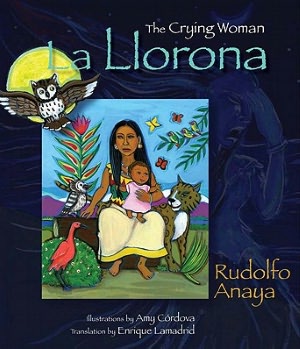
Ask any Mexican kid about La Llorona and their eyes will get really big!  They all know at least one of its numerous versions.  Only recently was it made very gruesome in a movie version.  Before that it was not told as something gruesome, but just a scary ghost story – with a warning that infidelity might be very costly!  This version is good because it is written by native Spanish speakers and has a very authentic Mexican flavor.


I’ve actually never read The Mud Pony in English, but I like the Spanish version (El Poni De Barro).  It captures the closeness to the earth that Native Americans have had in way that is accessible to kids – through the horse. 

Sunday, February 12, 2012

TRADITIONAL LITERATURE


As an introduction to this unit, I chose Julius Lester's beautifully written and illustrated tale of John Henry.  Here is the legend of the man who challenged the new steamdrill.  The stakes were high:  if the power of John Henry's own hand could not outdo the steam drill, he and countless other workers would become obsolete.  My question to students would be, what is the "steam drill" in your life that threatens to overtake you?  Will you fight it or give up?  How do you want to be remembered?